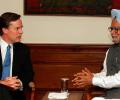
The India-US nuclear deal was aimed at ending India's nuclear isolation and nuclear apartheid, recalls Rup Narayan Das.

Seeking to dispel their apprehensions, Saran is expected to highlight New Delhi's impeccable record on non-proliferation front.
Before going in for talks, Burns told media persons that the two countries had come a long way in the talks on the agreement since the negotiations began two years ago.
The two sides will seek to wind up the year-long negotiations ahead of the meeting between Prime Minister Manmohan Singh and US President George W Bush in Germany next week on the sidelines of the G-8 Summit.
Burns and other senior administration officials had hoped that the negotiations over the 123 Agreement last month in New Delhi would resolve any pending issues so it could be sent up to Congress for review.

'If they are implying that they are going to have Congressional action by the time Bush goes to India, I believe the administration is setting out a very tough task for itself,' feels South Asia expert Robert M Hathaway.
Noting India's strategic importance in American efforts to limit the Chinese influence, a former top diplomat on Friday said the United States should include New Delhi in its East Asia policy.
During the Saran-Burns meeting, the Indian side is expected to assess what steps the US government is taking to ensure that the deal is cleared by the Congress.
Burns, the Under Secretary of State for Political Affairs who played a key role in clinching the deal, will address a talk on "India and Pakistan: On the Heels of President Bush's Visit" on Monday.
Karl F Inderfurth, who was Assistant Secretary of State for South Asian Affairs in the Clinton administration, and Nicholas Burns, who was Under Secretary of State in the Bush Administration, told rediff.com that Obama's endorsement during his address to a joint session of Parliament thus made his visit to India transformational too in a sense as had the trip by Clinton in March of 2000 and Bush in March 2006.
The Iranian nuclear issue, which threatens to snowball into a major issue, is also likely to figure at the two-day talks.
Former Indian Foreign Secretary, Shyam Saran will headline a major conference this week on the expectations and consequences of the US-India Nuclear Agreement, hosted by The Brookings Institution,
India is particularly interested in modifying provisions pertaining to conditional access to fuel reprocessing and caveats about future nuclear tests
Both sides, however, refused to provide a timeline.
Former foreign secretary Shyam Saran, who was the original Indian interlocutor of the US-India civilian nuclear deal negotiations with erstwhile US Under Secretary of State for Political Affairs Nicholas Burns, is unapologetic about his recent remarks at the India Habitat Centre lecture series in New Delhi which left many foreign policy experts both in India and the US puzzled.
According to sources in the Ministry of External Affairs, the text will be simultaneously released in Washington and New Delhi.
Burns said, "We'll continue to watch India's relations with Iran, and we'll obviously respond very respectfully to any concerns by members of our own Congress as we should do."
No dilution of language in the House and Senate bills is likely during the House-Senate conference that will meet on the United States-India civilian nuclear agreement when Congress reconvenes this week.
Nicholas Burns noted that the Administration had been informed the Senate and House would meet in the early part of December to reconcile both bills.
US Under Secretary of State for Political Affairs Nicholas Burns -- the chief interlocutor of the US-India civilian nuclear deal -- who will resign in March, has said he is elated that India has asked its Ambassador to Washington Ronen Sen to stay on for another year, describing it as "good karma".
Venkayya, who announced that he will join the Bill and Melinda Gates Foundation, becomes the second Indian American to walk away, following close on the heels of Karan Bhatia, who resigned as deputy United States trade representative in October.
"We hope that India, as well as all other states -- China, Russia, France, Britain and Japan -- will diminish their economic relations with Iran," US Under Secretary of State Nicholas Burns said.
In what diplomatic observers have described as "a make or break" round of negotiations, senior US and Indian officials held several hours of intense discussions at the State Department on Tuesday in an attempt to seal the 123 Agreement.
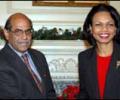
It will end India's nuclear isolation, he noted. Ahead of his visit here, Burns said last week that 90 per cent of the work has been completed and he would be making the "final effort".
Significantly, the meeting between Menon and Burns on Tuesday will take place 10 days after senior officials from the two sides met in the South African city of Cape Town.
Menon will undertake a two-day visit from April 30 during which he will hold talks with US Under Secretary Nicholas Burns on the 123 agreement amid indications that Washington was 'frustrated' at the speed of the negotiations.
Burns said from an American perspective, 'India and America have a common interest to thwart terrorism in our own regions and globally.'
When a media person asked why despite the affinity the United States had such a hard time endorsing India's bid for a permanent seat in the United Nations Security Council, Burns went into a spin.
Burns said that "We obviously wish to see no more terrorism emanating from Kashmiri separatist groups. We have told the Pakistani government that we would hope that it uses influence with these terrorist groups to stop attacks.
Both need to tackle Kashmiri militants together, Nicholas Burns said.
